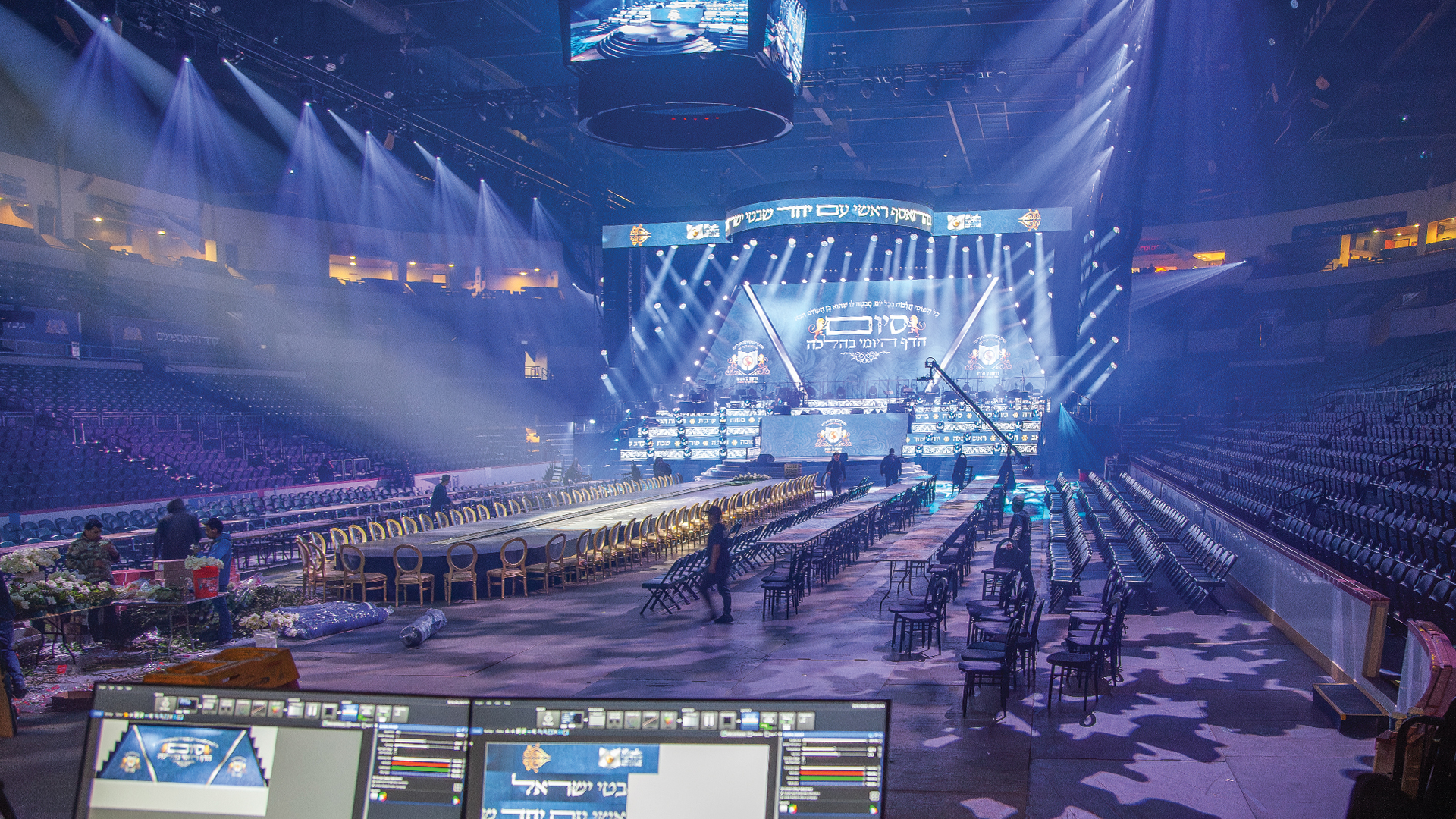
When a global product launch unfolds simultaneously across a hotel ballroom in Tokyo, a convention center main hall in London, and an outdoor amphitheater stage in São Paulo — all broadcasting from a central production in New York — the challenge is not simply providing a consistent visual experience across four different technical environments. It is ensuring that LED wall content designed for one specific pixel configuration, aspect ratio, and ambient light environment translates perfectly to three other environments with entirely different specifications, each serving a live audience for whom the visual experience is their primary touchpoint with the brand event they are attending. LED wall content scaling across multiple simultaneous locations is one of the most technically complex disciplines in contemporary event production.
The Resolution Problem: One Asset, Many Grids
LED wall content is created at specific pixel resolutions determined by the physical pixel count of the primary installation. A main stage LED wall comprising 192 panels of ROE Visual BP2V2 (3840 × 2160 pixels per panel at 600mm × 337.5mm) produces a physical resolution that is unlikely to be replicated exactly at any secondary location. The content scaling workflow must convert this master resolution to each secondary location’s physical pixel grid without introducing the scaling artifacts — aliasing, blockiness, or motion blur — that result from naive integer-ratio scaling. disguise media servers handle this through their output resolution mapping system, which allows each output to be assigned an independent resolution and aspect ratio while sharing the same content layer — effectively running independent scaled renders of the same content simultaneously for each location.
Indoor vs. Outdoor: The Brightness Calibration Challenge
The simultaneous deployment of LED content across indoor and outdoor environments creates a brightness calibration challenge that begins at the content design stage and continues through the technical delivery pipeline. An indoor ballroom environment optimized at 1,000 nits of LED output will produce a visual result that appears completely different from the same content running at 4,000 nits on an outdoor stage in afternoon sunlight. Content designed at indoor brightness levels will appear washed out and low-contrast when scaled to outdoor brightness; content designed for outdoor readability will overpower the indoor environment and destroy the carefully designed ambient atmosphere. The solution — parallel content grading in which the same creative content is graded for both brightness environments — adds production cost but is non-negotiable for premium multi-location events. Adobe Premiere Pro’s Lumetri color grading tools and DaVinci Resolve’s node-based color pipeline are both used for this parallel grading workflow.
Network Architecture: Distributing Content Globally
Distributing LED wall content across multiple international locations requires a network architecture capable of carrying the bandwidth of uncompressed or lightly compressed video content with the latency tolerance that live event production demands. JPEG 2000 codec — the broadcast industry’s preferred format for low-latency video over IP — is increasingly used for multi-location event video distribution, carried over dedicated fiber circuits or high-bandwidth MPLS networks provisioned specifically for event production. The Haivision SRT protocol (Secure Reliable Transport) provides an alternative pathway for productions where dedicated fiber circuits are not available, using adaptive bitrate and forward error correction to deliver reliable high-quality video over public internet infrastructure. At the destination, Barco E2 or Analog Way Aquilon RS screen management systems handle the incoming signal and route it to the local LED processing infrastructure.
Aspect Ratio Mapping: When the Wall Shape Changes Everything
The most creative challenge in multi-location LED content scaling is handling aspect ratio differences between primary and secondary locations without destroying the compositional intent of the original design. A 21:9 ultra-wide wall at the primary production location becomes a 16:9 wall at a secondary location and a portrait-format 9:16 installation at a third; the content’s visual grammar — the way elements are positioned within the frame, the way text reads, the way transitions are designed — must remain coherent across all three geometries simultaneously. disguise’s generative content tools and Resolume Avenue’s multi-output architecture both provide aspect-ratio-aware content containers that reformat content dynamically for each output. Content designers working on multi-location events build their assets with this scaling in mind from the first frame — designing visual elements that remain legible and compositionally effective across the range of aspect ratios they will encounter.
Case Study: Global Corporate Launch Across 12 Cities
A 2022 global technology product launch — delivered simultaneously to 12 cities across 6 time zones, each with a local live audience and a locally produced ambient event environment — deployed LED walls with configurations ranging from a primary 30-meter wide curved installation in New York to a 6-meter flat installation in a Singapore hotel ballroom. The content production team, working in Cinema 4D and Adobe After Effects with a disguise preview environment, built all primary content at 7680 × 1440 pixels (the primary wall’s native resolution) and then used disguise’s multi-output scaling tools to generate secondary format derivatives automatically. A dedicated network engineering team provisioned dedicated 10 Gbps fiber circuits between all 12 locations, with Telestream Lightspeed Live encoders handling the compression and transport at each node. The broadcast director, working from New York, could monitor the live output at every location simultaneously through a 12-way multiviewer display.
The Role of Cloud in Multi-Location LED Production
Cloud-based media asset management and content distribution are increasingly embedded in multi-location LED wall production workflows, particularly for events where content is updated frequently and needs to be distributed to multiple locations on short notice. Frame.io’s enterprise media review platform allows content creators to share updated content files with technical directors at all secondary locations in real time, replacing the previously standard workflow of physically shipping hard drives or using consumer file-sharing services with inadequate version control. AWS MediaPackage and Azure Media Services provide the cloud infrastructure for adaptive bitrate streaming of LED content to secondary locations that lack the dedicated fiber circuits suitable for professional-grade video transport. These cloud tools don’t replace the technical complexity of multi-location LED production — they manage the logistics of that complexity more efficiently than previous workflows could.
Quality Control: Monitoring What Every Audience Sees
The quality control challenge of a multi-location LED wall production is proportionally more complex than a single-location event: the production team must verify that every audience at every location is seeing a visual experience that meets the event’s quality standard simultaneously, often with limited or no direct visibility into what the local audiences are actually experiencing. Remote video monitoring infrastructure — live camera feeds from each location transported to the primary production location’s monitoring wall — provides the technical director with visual confirmation of each local LED system’s output in real time. Color reference cards deployed at each location at the start of the event production and captured on the monitoring cameras provide a calibration reference that allows the technical director to verify that each location’s LED system is performing within the specified color accuracy parameters. This infrastructure investment — significant in both cost and pre-event coordination — is what distinguishes a multi-location LED production that delivers consistent brand quality from one that simply appears in multiple places simultaneously.
AV Production Insights | Professional Series
