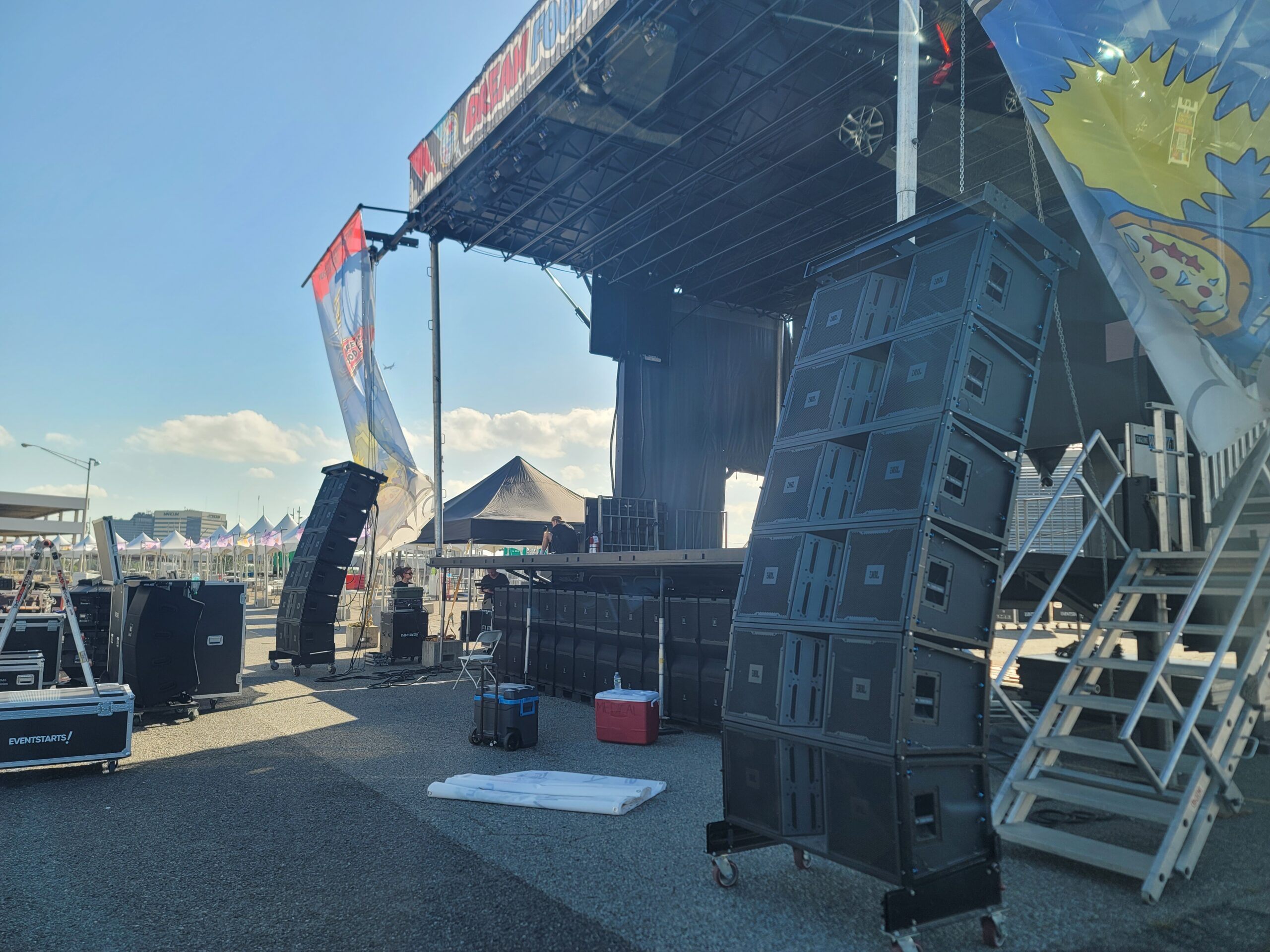
The sound reinforcement system was supposed to deliver crystal clarity to eighteen thousand people. Instead, it delivered what the crew would later describe as “demonic possession in speaker form.” Unexplained feedback howling through the L-Acoustics K2 arrays. Subwoofers producing frequencies the laws of physics said shouldn’t exist. The Lake processing displaying error codes that even the manufacturer’s hotline couldn’t interpret. This is what happens when a PA system decides the humans work for it, not the other way around.
The Evolution of Audio Warfare
Understanding modern PA system failures requires appreciating how far the technology has traveled. In the 1960s, Bill Hanley pioneered large-scale sound reinforcement using wall-of-sound approaches—massive speaker stacks that achieved coverage through sheer quantity. Problems were mechanical: blown drivers, failed cables, overheated amplifiers. Diagnosis was straightforward because systems were fundamentally simple.
Today’s line array systems from manufacturers like d&b audiotechnik, Meyer Sound, and JBL Professional are networked computers disguised as loudspeakers. Digital signal processing happens at every stage. Network protocols carry audio data alongside control commands. A single misconfiguration can cascade through the entire system faster than any technician can react.
The Festival That Forgot How to Listen
A major electronic music festival contracted one of the industry’s most respected sound companies to provide a flagship Meyer Sound LEO system for their main stage. The design was textbook perfect—arrays angles calculated using MAPP 3D prediction software, subwoofer deployment optimized for the venue geometry, delay towers positioned to extend coverage without creating timing conflicts.
Soundcheck proceeded smoothly. The headliner’s production manager signed off on the mix position. Then the gates opened, forty thousand people filled the field, and the PA system apparently decided it had other plans.
Chasing the Phantom Feedback
The first indication of trouble came during the opening act: a low-frequency oscillation that no amount of parametric EQ adjustment could tame. The FOH engineer worked the Yamaha RIVAGE PM7 with surgical precision, cutting frequency bands, adjusting crossover points, but the oscillation persisted. It seemed to move—loudest in one zone, then migrating to another, never quite where the measurements said it should be.
The culprit proved almost impossibly subtle. A firmware update on the Meyer Sound Galileo GALAXY processor had changed how certain filter types interacted with specific driver configurations. The update was designed to improve performance, but it created a resonance condition that only manifested at high SPL with crowd absorption patterns matching certain density profiles. In other words, the problem literally appeared only when the audience reached a specific size.
The Network That Ate Itself
Modern audio networking relies on protocols like Dante, AVB, and AES67 to distribute audio signals across complex systems. These protocols are engineering marvels, but they introduce failure modes that analog audio never experienced. A broadcast at a major sports venue encountered this reality when their Dante network suddenly developed packet loss during a nationally televised event.
The A1 audio engineer watched helplessly as channels began dropping intermittently. The DiGiCo Quantum 7 console showed green status lights everywhere, but the sound reaching viewers at home stuttered and glitched. The problem: a switch somewhere in the venue’s infrastructure had developed a fault that corrupted multicast traffic. Finding that switch among hundreds of network devices took three hours—well after the broadcast ended.
Subwoofers With Attitude Problems
Low-frequency reinforcement presents unique challenges that high-frequency systems don’t share. Subwoofer arrays must be precisely aligned to achieve coherent summation; misalignment creates cancellation zones where bass simply disappears. A touring production encountered this when their d&b audiotechnik SL-SUB cardioid arrays began exhibiting coverage patterns that matched no simulation.
The system technician ran extensive measurements using a Smaart measurement system, confirming that rear rejection had degraded substantially from previous venues. Physical inspection revealed that someone during load-in had accidentally swapped polarity on internal wiring within two subwoofer cabinets. The error was invisible to any diagnostic except careful measurement—the cabinets produced sound, just the wrong sound.
The Wireless Wars
Every major production now navigates an increasingly crowded RF spectrum. Wireless microphone systems from Shure Axient Digital, Sennheiser Digital 6000, and Audio-Technica 5000 series compete with wireless in-ear monitors, intercom systems, and an ever-increasing density of consumer devices carried by audience members.
A theatrical production discovered this competition dramatically when audience smartphones began interfering with their body pack transmitters. The interference manifested as subtle artifacts during quiet moments—clicks, pops, and brief dropouts that no amount of frequency coordination could eliminate. The solution required moving to frequencies that the RF coordinator had originally avoided for other reasons, accepting compromises in range to achieve interference immunity.
When Processors Develop Personalities
Digital signal processing enables capabilities that analog systems couldn’t match: complex crossover networks, real-time room correction, network-based system control. But DSP systems can fail in ways that seem almost malicious. A corporate event using a Biamp TesiraFORTÉ DSP platform experienced random volume fluctuations that defied explanation.
The system would function perfectly for hours, then suddenly attenuate certain outputs by random amounts. Levels would jump or drop mid-sentence. The control software showed stable settings that didn’t match what the system actually delivered. Ultimately, the problem traced to a memory allocation issue that only manifested under specific processing loads—a bug that existed in the firmware but had never been triggered in testing environments.
The Art of Audio Triage
Experienced system technicians develop diagnostic frameworks for audio emergencies. The signal flow methodology—tracing audio from source to destination, checking each processing stage—remains fundamental. But modern systems require additional approaches: network analysis, firmware version tracking, processor load monitoring.
The best technicians maintain detailed documentation of working configurations, creating baselines against which problems can be identified. They know the specific amplifier firmware versions that play well with their loudspeaker management systems. They’ve memorized which processing configurations work reliably and which combinations create mysterious interactions.
Building Systems That Fail Gracefully
Redundancy in professional audio systems goes beyond simply having backup equipment. Smart system design creates multiple signal paths that can compensate for individual failures. Matrix mixing allows alternative routings. Parallel processing chains provide failover options. Network configurations with multiple paths prevent single points of failure.
The L-Acoustics LA Network Manager includes monitoring features that can alert technicians to developing problems before they become audible. d&b ArrayCalc simulations can predict coverage issues before a single cabinet leaves the truck. These tools represent decades of lessons learned from systems that misbehaved at the worst possible moments.
Human Factors in System Failures
Not every PA system failure stems from equipment malfunction. Human error accounts for a substantial percentage of audio disasters. Cables connected to wrong channels. Processors configured for different loudspeaker models. Show files loaded from incorrect projects. The technology is only as reliable as the people operating it.
Training investments pay dividends when crises occur. A system engineer who truly understands ArrayProcessing algorithms can diagnose optimization failures that would baffle a less experienced technician. An FOH engineer familiar with console architecture can implement workarounds that preserve show continuity even when primary systems fail.
The Ongoing Battle for Audio Sanity
Every production represents a negotiation between ambition and reliability. Sound system designers push boundaries, deploying complex configurations that deliver unprecedented sonic experiences. Meanwhile, the entropy inherent in any complex system works continuously to undermine those achievements. The PA system doesn’t actually laugh at the crew—but some days, it certainly feels that way.
The professionals who thrive in live sound production embrace this reality. They prepare obsessively, maintain their equipment religiously, and develop intuition for systems on the edge of misbehavior. They know that the PA will eventually do something unexpected. Their job is ensuring that when it does, they have the skills and resources to respond before the audience notices.
And they always, always, have spare cables. Because sometimes the most sophisticated digital audio system in the world fails because of a five-dollar connector that chose the wrong moment to oxidize. The technology advances; the fundamentals remain eternal.
Keywords: sound reinforcement system, L-Acoustics K2, Lake processing, PA system failures, Bill Hanley, line array systems, d&b audiotechnik, Meyer Sound, JBL Professional, Meyer Sound LEO, MAPP 3D, production manager, parametric EQ, FOH engineer, Yamaha RIVAGE PM7, Galileo GALAXY processor, audio networking, Dante, AVB, AES67, A1 audio engineer, DiGiCo Quantum 7, subwoofer arrays, d&b SL-SUB, Smaart measurement, wireless microphone systems, Shure Axient Digital, Sennheiser Digital 6000, Audio-Technica, body pack transmitters, frequency coordination, RF coordinator, Biamp TesiraFORTÉ, system technicians, signal flow methodology, amplifier firmware, loudspeaker management, professional audio systems, matrix mixing, L-Acoustics LA Network Manager, d&b ArrayCalc, PA system failure, system engineer, ArrayProcessing, sound system designers, live sound production, digital audio system
