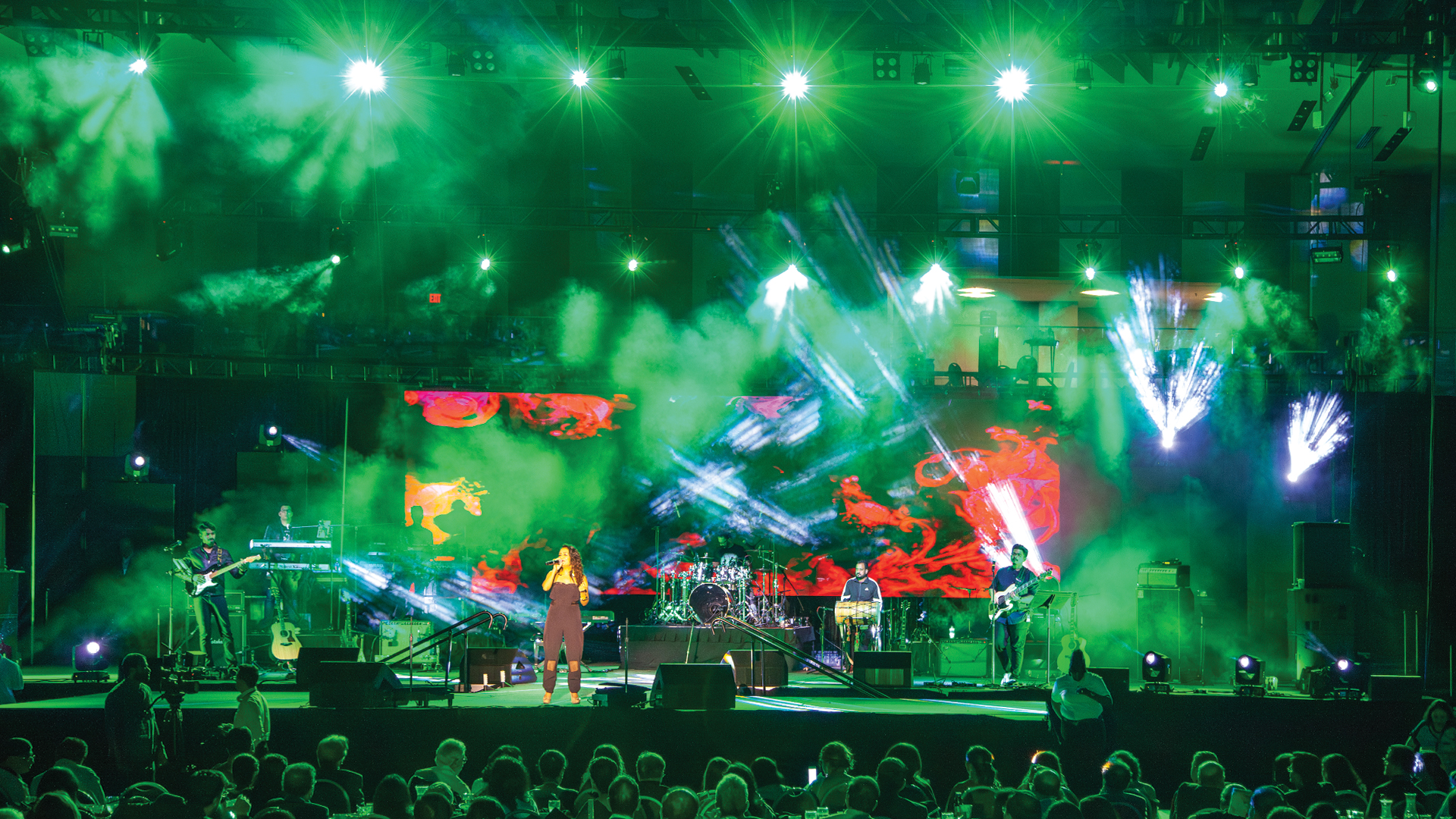
Lighting design at scale is one of the most misunderstood disciplines in live event production. A large stage lighting design that looks spectacular to 10,000 audience members can simultaneously make your keynote presenter look washed out, shadowed, ill, or ghostly on camera — and in a world where hybrid events are the norm, camera performance is every bit as important as the live visual experience. Balancing these competing demands is where great lighting designers earn their reputation.
The fundamental tension is simple: stage wash intensity and presenter key light exist in a perpetual tug-of-war. Corporate events demand the branding power of dynamic color washes, beam fixtures, and LED walls. But that same energy, applied without discipline, turns your CEO into a silhouette against a blazing graphic wall, or buries them in a sea of competing atmospheric light that cameras cannot resolve.
The Camera Exposure Problem: Why It Dictates Everything
When designing for camera-friendly stage lighting, your starting point is the camera exposure latitude. Modern broadcast cameras like the Sony FX9, Canon EOS C500 Mark II, or Blackmagic URSA Broadcast can handle dynamic range of 14–15 stops. But your video director will likely shoot in a narrower exposure window to maintain consistent quality across a multi-camera live cut. This means the difference in brightness between your presenter’s face and the LED wall behind them must stay within a manageable ratio — typically no more than 3:1 to 5:1 for broadcast work.
The key-to-background ratio is your most powerful tool. Measure the LED wall brightness in foot-candles or lux, then set your presenter key light accordingly. A Sekonic L-858D incident light meter becomes an indispensable tool in the pre-show workflow of any LD who takes camera performance seriously.
Historical Context: How Stage Lighting Evolved
The modern approach to large-scale event lighting design owes a debt to theatrical tradition. From the introduction of limelight in the 1820s to the widespread adoption of tungsten Fresnels in mid-20th century television studios, the challenge of illuminating a single human face against a complex background has always defined the art. The emergence of automated moving light fixtures in the 1980s — pioneered by systems like the Vari-Lite VL1 used at Genesis concerts — democratized dynamic stage lighting. By the early 2000s, LED technology began displacing conventional tungsten and HMI fixtures, fundamentally changing how LDs approach intensity control and color temperature management.
Key Light Strategy for Large Stages
On stages wider than 40 feet, a single follow spot or a narrow key light angle becomes impractical for covering presenter movement. Professional LDs use zone-based key light systems that divide the stage into addressable areas, each with dedicated front-of-house ellipsoidal fixtures or automated spots. Fixtures like the ETC Source Four LED Series 3, Robe T11 Profile, or Martin MAC Ultra Performance provide the beam control and output necessary to punch through ambient wash without overpowering the environment.
The key light angle matters enormously. A 45-degree key light elevation — the classic Rembrandt angle — creates pleasing facial modeling while minimizing harsh shadows. Flatter angles under 30 degrees risk washing out facial features; steeper angles above 60 degrees cast unflattering nose and eye shadows. For events with IMAG (image magnification) screens, this angle discipline is non-negotiable — every shadow reads ten feet tall on screen.
Managing the LED Wall’s Influence
The LED video wall is simultaneously the most powerful visual asset and the most dangerous lighting source on a modern corporate stage. LED walls emit enormous amounts of omnidirectional light — a 30×15-foot wall at full brightness can generate more incident light on the presenter than your entire key light rig. This phenomenon, known as LED wall spill, must be actively managed.
Solutions include reducing the video wall’s overall brightness — often done through the Brompton Technology Tessera processing or Novastar VX series controllers — to a level that looks spectacular in the room while remaining camera-manageable. Most experienced production designers target 100–150 nits for the on-stage wall sections behind talent, reserving higher brightness for flanking panels and audience-facing surfaces.
Color Temperature Discipline
Mixing color temperature sources on a corporate stage creates nightmare scenarios for video color correction. When your key lights are at 5600K (daylight), your fill lights are at 3200K (tungsten), and your LED wall is somewhere in between, the camera’s white balance becomes a compromise that makes nobody look correct. Discipline means committing to a unified color temperature — typically 4000K to 5600K for broadcast environments — across all fixture types affecting talent areas.
Modern LED fixtures from manufacturers including Chroma-Q, Arri SkyPanel, and Litepanels Gemini offer tunable white output that can be precisely matched and maintained throughout a show. Use your lighting console — whether a grandMA3, Avolites Sapphire Touch, or ETC Eos Ti — to store color temperature values as palettes, ensuring consistent recall regardless of scene transitions.
The Collaboration Triangle: LD, Video Director, and Client
The most successful large-stage productions treat lighting and video as a unified discipline. This means the LD, video director, and creative director must align on exposure targets, color temperature decisions, and movement zones before a single fixture is focused. A pre-production camera test — shooting talent on the actual stage with final content on the LED wall — is not a luxury; it is standard professional practice. What looks great in the design software will always surprise you in the room. The camera does not lie, and the presenter deserves to look their best under every lighting condition you create.
